Spitfire BS410 History

BS410 Mk IX fitted with a Merlin 61
Soon to fly again, this Mk IX Spitfire, owned and rebuilt by Martin Phillips. A combat veteran of some 35 sorties in the European Theatre of war. Her last pilot was Pilot Officer Piotr Kuryllowicz of 315 (Deblin) Squadron when on 13 May 1943, during ‘Ramrod 71’. He had to abandon the aircraft after its cooling system was damaged in combat.
The Spitfire crashed in marshland near Occoches, northwest of Doullens in France’s Somme department. Piotr was captured by the Germans and sent to Stalag Luft 3, taking an active part in several escape attempts and also surviving the ‘Long March’. Fortunately he survived the war and is still alive, living in Canada at the grand old age of 102!!.
The aircraft has a fascinating history, being flown by Francis ‘Gabby’ Gabreski who flew the aircraft with 315 Squadron to gain European theatre combat experience. He was later to make his name flying P-47s with the USAAF’s 56th Fighter Group becoming the top scoring 8th Air Force fighter Ace in Europe with 28.5 victories in World War II, plus further 6.5 in Korea.
As well as carrying out 35 operational sorties with 315 Squadron including Ramrods, Rodeos, Circus, and escort sorties she also has been flown by a number of well know Polish Battle of Britain pilots and aces. Her other claim to fame came on the 27 Feb 1943, when Pilot Officer Blok of 315, took BS410 on a patrol over Wembley stadium for the England V Wales football match! Here is her full story!
Manufactured Chattis Hill, following the bombing of Woolston, the decision was made to disperse Spitfire production. Chattis hill was chosen as one of the sites ,and assembly sheds were constructed to the north of the WW1 aerodrome. A new airfield was used to the west of the original site. The whole operation was well camouflaged. Supermarine commenced operations in December 1940,with the first aircraft delivered out in March 1941.The use as a Spitfire assembly plant continued until 1945 when the airfield was closed, although Supermarine used the buildings until May 31st 1948.
BS410 was ordered from Vickers Armstrong (Supermarine) on 24 October 1940 as one of 1,100 F.I aircraft but was eventually built at Salisbury as a Merlin 61-powered F.IX in the batch BS383-411; final assembly was at Chattis Hill, from where it made its first flight on 28 October 1942.
The Spitfire was allocated to No. 315 (Deblin) Polish Squadron, based at RAF Northolt on 6 November 1942. Between November 1942 and early April 1943 BS410 carried the squadron code letters ?PK-E but these were changed to ?PK-A by mid-April. In March 1943 BS410 was sent to Air Service Training at Hamble for fitting of the camera gun in the starboard wing root,before re-joining No. 315 Squadron at Northolt.
She was was with 315 City of Deblin Polish Squadron at RAF Northolt, throughout her short life. Spitfire IXs arrived and re equipped the squadron from their Mk VB in Nov 1942, 315 flew its first operational patrols with the Mk IX Spitfire on the 30 November 1942.
BS410 flew her first operational sortie with Flying Officer F Wiza, taking off at 09.55 Hrs on a squadron strength sweep around the Ypres and Hardelot area at 27,000 feet. Although they received warning of enemy aircraft in the locality, non were seen and nothing engaged. Two of the new Mk IXs had engine trouble but they all returned to the airfield. One of these was BS 410 as she arrived home 15 minutes before the other aircraft at 11.30 Hours.
Frantiszek Wiza although of Polish parentage, he was born in Lubeck, Germany on 28 February 1916. Having made it to the Uk he attended 58 OUT in August 1942 and arrived on 315, his first operational squadron in December 1942 about the same time as BS410. He later served on 316 and 302 Squadrons returning to 315 in April of 1944. He was awarded the Polish KW and 2 bars (Kryz Waleczynch) as well as the RAF DFC in 1945 having claimed 3 aicraft destroyed, 1 probable and 2 damaged as well as 2 and 1 shared victories over V1 flying bombs. He survived the war and lived in Australia where he became a civilian pilot New Holland Airways and then for Australian Fighter Ace, Bobby Gibbes and his airline Gibbes Sepik Airways. He passed away in 1956 aged just 40 years old.
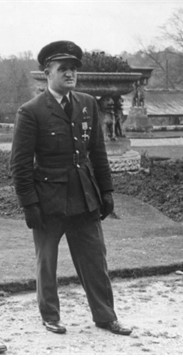
Frantiszek Wiza getting awarded his DFC
That afternoon she was airborne again with a different pilot, this time Sgt K Lojeck. He had a crash later on 9 October 43 while he was flying Supermarine Spitfire V BM144 PK-O. F/Sgt K. Lojek was injured, and the aircraft written off during a training accident.His luck finally ran out on the 6 January 1944 when his Spitfire Mk.Vb P8744 PK-B was shot down by fighters of JG2 near Le Mesnil. Three German pilots claimed Spitfires at this time in this location. They were Oberfeldwebel Willi Stratmann, Oberfeldwebel Meindl and Oberfeldwebel Karl-Heinz Munsche.
On this sortie he flew BS410 on Rodeo 115 around Abeville, coasting out at sea level and then climbing up to 23,000 feet so that the Germans new they would be coming as they popped up out of the ground clutter. The squadron would hope that this would entice up a few Fw190s for combat but although they encountered flak and were warned of enemy aircraft in the area, nothing was seen, and they headed home. Wheels down on the tarmac at 15.25 Hours after a sortie of two hours.
On the 5 December, BS410 was paired with a Sergeant Bogdan Smidowicz (later commissioned and survived the war) For Rodeo 124 which would see the squadron head round the Cherbourg Peninsular. They received warning again of bandits in the area, 10 enemy aircraft had been spotted just as the squadron crossed the French coast, it seemed that the game was on. Sadly, nothing materialised to have a go at an although they spotted a few aircraft, nothing was engaged and they headed home.
The next day saw a sortie chalked up on the ops board for Circus 241. This time with a Sergeant Eugeniusz Stanis?aw Rembowski at the controls. (Later flew with 306 and 300 Squadrons, he lived in the UK post war and dies in Blackpool in 1994) His role was as part of a cover wing for 18 B17 Flying Fortress aircraft that were detailed to bomb Lille. They carried out a rendezvous five miles east of Dunkirk. Over Cassell, two Fw 190s made a chance attack on two of the B17s but without any affect. Two of the squadron had a go at catching the fighters but they were out of range. They were harried by mild flak over the target but no claims or losses on this sortie. Arriving home after a two-hour sortie touching down at 13.15 Hrs.
Flying Officer Wiza was back in the cockpit on the 12 December for circus 242, escorting bombers with a rendezvous over Hasting at 26,000 feet and routing Le Treport and Grandvilliers. Enemy aircraft were reported by control in the Locality and approaching from the South East but nothing was seen and the squadron arrived home at 12:45Hrs.
On the 14 December, Wiza flew 410 again for a 1:45 sortie down to the South Coast to carry out a patrol on a line between Shoreham and Selsey but no aircraft were spotted and they turned for home after and hour and a half.
Flying Officer C Tarkowski was the pilot for the afternoon sortie, departing at 14:25 hours on a Rodeo over Le Touquet and Dunkirk at 26,000 feet but again nothing was sighted and the 12 Spitfires landed back around 16:00 hrs.
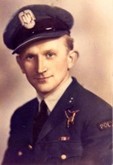
Czeslaw Tarkowski
Czeslaw Tarkowski was a Battle of Britain veteran. He was assigned, initially, to No.85 Squadron at RAF Church Fenton where he flew the Hawker Hurricane Mk.1. After a short spell with that Squadron, he quickly moved on to No.605 Squadron, based at the famous Biggin Hill sector station. When the “scramble” call came on the morning of the 8th November 1940, Tarkowski made his way over to his Hurricane, N2649, call sign UP-O and climbed up to meet the enemy. They were vectored to an incoming road over the Maidstone and Tunbridge area. They were in combat fairly quickly and he managed a quick shot at a passing Bf 109 but shortly after he was to become the victim. He bailed out of his doomed and smoking Hurricane, landing at Sissinghurst. He was believed to have been shot down by Major Gerhard Schopfel, flying a Bf109E attached to Jagdgeschwader 26 based at Caffiers in Northern France. Czeslaw Tarkowski ended the war with the rank of Squadron Leader. He only ever scored a single aerial victory, claiming a Junkers Ju188 on the night of the 3 March 1945 whilst at the controls of a De Havilland Mosquito of No.307 Squadron.
After the war, Tarkowski settled in England and had a successful career in aviation.
BS410 was rostered for a sortie on the 20 December with a take of time of 11:00 hrs. Its pilot for Circus 244 over Rouen was Sergeant Tadeusz Jankowski. Jankowski was quite an experienced pilot. After his time at 58 Operational Training unit in 1941 he first served on 308 Squadron before his posting to 315. He was then with 453 Squadron and 65 Squadron in 1942 before arriving back at 315 in October of that year. After serving as an instructor on 58 OTU through mid-1942 he re-joined 315 for a further tour of operations being awarded the Polish KW and 2 bars (Kryz Waleczynch) but he sadly was to lose his life flying a Mustang whilst operating in support of the Arnhem landings. He was also posthumously awarded the silver cross of Merit with swords. His claims amounted to two aircraft destroyed and 1 shared as well as a whole stack of V1 victories and shared kills over the flying bombs.
For this sortie Tadeusz took BS410 to the bomber rendezvous over Beachy Head and escorted them to Rouen. When they left the bombers, they saw enemy fighters! 12-14 Fw190s but they could not engage as they sipped away fast. The squadron had to land at RAF Kenley due to poor visibility at RAF Northolt.
BS410 and Jankowski were not required again until the 29 December when they took off on a Rodeo at 13:50 Hours 10 other Spitfires but the sortie was unsuccessful as they lost sight of the lead squadron. They landed back at 15:50 at RAF Northolt.
They were required again on the 30 December for Circus 243 where they routed out towards Cherbourg at 25,000 feet, experiencing some light flak near the bombers target and also, they again saw FW190s which evaded any combat, slinking away into the clouds before 315 could get near.
The last sortie of December was on the 31 December at the hands of yet another pilot. This time Flying Officer W Drecki (Wladyslaw Maciej Drecki) who took BS410 on a patrol between Shoreham and Selsey. He had fought against the Germans in Poland during September of 1939 and was injured in combat with a JU 87. He was awarded the Cross of Valour for his actions.
He managed to get to France and converted to the French Morane 406 in which he took part in the defence of Lyon when it was bombed. He arrived in England in June of 1940 and was posted to CFS Upavon and then 6 Operational Training Unit. He served with 317, 303,306 before 315 having arrived in December 42. He later served in Tunisia, Malta and Sardinia with 152 Squadron but was killed in a take-off accident in 1943. He had destroyed 4 enemy aircraft during his career and was awarded three bars to his cross of Valour as well as the Silver Cross of the Virtuti Militari.
On the 3 January 1943, F\L F Kornicki flew BS410 on Circus 247 to Havre with a 9:10 hrs departure and climb up to 26,000 feet. Sadly, nothing was seen, and the squadron landed back at Northolt at 11:25 hrs. An uneventful trip this time.
Franciszek Kornicki
By August 1940 the Polish Air Force already had more than 8,000 men on its strength in Britain and eventually it consisted of sixteen fighter and bomber squadrons had been formed which were operationally subordinate to the RAF. After flying training on the Boulton Paul Defiant he was posted on 11 October 1940 to 303 Squadron, just after it moved north to rest and reform after achieving in six weeks the highest score of all the squadrons that took part in the Battle of Britain. On joining 303 Squadron he converted to the Hawker Hurricane. In January 1941 he joined 315 Squadron, which in July moved to RAF Northolt and was reequipped with Spitfire MkIIs. On 23 July he flew his first mission over France, with the usual instructions to stick close to his section leader. He described the experience as follows: “We were over twenty thousand feet with France below us when I heard on the RT [radio transmitter] that enemy aircraft were approaching, and later there were reports of attacks and warning shouts – somebody was fighting somewhere. I thought we were moving about a bit nervously when I remembered the golden rule: never fly straight and level for any length of time – and so I too weaved behind my energetic leader, trying desperately not to collide with anybody and not to lose him. I managed, but I did not see much else except him and my immediate neighbours. Our squadron was not molested, and we all came back in one piece. I landed drenched with perspiration, jumped out of my aircraft, lit a cigarette and inhaled deeply”
On 13 February 1943, he took over command of No. 308 Polish Fighter Squadron: at 26 he was the youngest squadron commander in the Polish Air Force and the first from the twelfth entry at D?blin to reach such a position. At the end of the month he came down with appendicitis, and on 7 May he became commanding officer of No. 317 Polish Fighter Squadron, which he led until December 1943. From January 1944, having survived over three years as a fighter pilot, Kornicki was transferred to a ground job as a liaison officer. He then attended the Polish Air Force Staff College in Weston-Super-Mare, after which he served in staff positions at 84 Group HQ, 2nd Tactical Air Force, in the Netherlands, Belgium and Germany. As a staff officer he was forbidden to fly operational sorties but he had just received permission to retrain on the latest model of Spitfire when the war in Europe came to an end. For his wartime service he was awarded the Silver Cross of the Virtuti Militari (War Order No. 08487) and the Cross of Valour with two bars.
On the same day BS410 was up yet again with the pilot this time being , F\O B Semmerling on a Rodeo to Cherbourg 14:25 hrs-16:05 hrs.
Flying Officer Brunon Semmerling
Was to become a decorated pilot who received the Cross of valour and a bar as well as a Military Cross. He joined 315 Squadron during Feb 1942 and served with them till Oct1943 .Semmerling was to be shot down on 13 march 1943, when 315 were escorting B-17s. He bailed out and evaded capture. After his return to England he re-joined the squadron. Later he worked for the British Intelligence (he had a pre-war training in Poland as a counterintelligence agent) and was smuggled several times in and out the occupied France. Sometime after the war he returned to Poland where he passed away in Czarnkow.
The 9 January 1943 saw BS410 on Circus 248 with Sgt K Jankowski back at the controls (see 20 December 42 entry for Biography) This Circus saw 315 rendezvous with Bostons over Beachy Head at 500 feet, but as they climber up the weather worsened and the whole show was called off.
On the 11 January 1943, 315 were tasked to carry out a sweep over St Omer with Bs 410 being flown again by Sgt K Jankowski. but no enemy fighters were seen, even though they received a warning from control of Bandits in their vicinity.
The 13 January 1943 saw the crews briefed for Circus 249 which entailed top cover for Ventura’s bombing Abbeville, again with Jankowski at the controls. A rendezvous with the bombers over Beachy Head at a height of 500 feet. They then climbed up to 24,000 feet over the target area. Luckily the flak was ineffective, and no fighters were encountered.
On the 14 January 1943, BS410 was scrambled to patrol a line from Shoreham to Selsey to combat hit and Run raiders that might sneak in along the coast. This time with Pilot Officer Panek in the hot seat but no enemy aircraft were seen in the vicinity.
P1730 Flying Officer Przemyslaw Panek joined315 in December 1942 and remained with them until April 1943. He was later shot down over France (Ramrod 51) by anti-aircraft fire. He is Buried at St. Sever cemetery in Rouen. section 1, row G, tomb 12.

Panek on the right.
The 20 January 1943 saw Paneck back in BS410 twice that day for a scramble to meet incoming rads over London, but both were uneventful, and no enemy aircraft were seen.
On the 21 January 1943, BS410 went on Circus 252 with Captain G Gabreski on his first operational flight. This entailed a rendezvous at Shoreham at 500 feet with a climb up to 13,000 feet, heading for the target area around Tricqueville. They encountered light flak in the Havre area and reports again of enemy aircraft, but no one could engage.
Gabi Gabreski
At the start of his second year at Notre Dame, Gabreski enlisted in the United States Army Air Corps, volunteering as an aviation cadet. After his induction into the U.S. Army at Pittsburgh, he undertook primary flight training at Parks Air College, near East St. Louis, Illinois, flying the Stearman PT-17. Gabreski was a mediocre trainee and was forced to pass an elimination check ride during primary to continue training.
He advanced to basic flight training at Gunter Army Air Base, Alabama, in the Vultee BT-13 and completed advanced training at Maxwell Field, Alabama, in the North American AT-6 Texan. Gabreski earned his wings and his commission as a second lieutenant in the Air Corps in March 1941, then sailed for Hawaii aboard the SS Washington to his first assignment.
Assigned as a fighter pilot with the 45th Pursuit Squadron of the 15th Pursuit Group at Wheeler Army Airfield, Hawaii, 2nd Lt. Gabreski trained on both the Curtiss P-36 Hawk and the newer Curtiss P-40 Warhawk. He met his future wife, Catherine “Kay” Cochran, in Hawaii and became engaged shortly after the Japanese attack on Pearl Harbor. During that action, Gabreski joined several members of his squadron in flying P-36 fighters in an attempt to intercept the attackers, but the Japanese had withdrawn. During the spring and summer of 1942, Gabreski remained with the 45th (renamed as 45th Fighter Squadron in May 1942), training in newer model P-40s and in Bell P-39 Airacobras that the unit began to receive.
He closely followed reports on the Battle of Britain and the role played in it by Polish RAF squadrons, especially by the legendary No. 303 Polish Fighter Squadron. He became concerned that the US did not have many experienced fighter pilots. This gave him an idea: since Polish squadrons had proved to be capable within the RAF and since he himself was of Polish origin and spoke Polish, he offered to serve as a liaison officer to the Polish squadrons to learn from their experience. The idea was approved, and he left Hawaii for Washington, D.C. in September 1942, where he was promoted to captain.
RAF duty
In October, Gabreski reported to the Eighth Air Force‘s VIII Fighter Command in England, at that time a rudimentary new headquarters. After a lengthy period of inactivity, he tried to arrange duty with 303 Squadron, but that unit had been taken out of action for a period of rest. Instead, he was posted to No. 315 (Deblin) Squadron at RAF Northolt in January 1943.
Gabreski flew the new Supermarine Spitfire Mark IX, flying patrol sweeps over the Channel. He first encountered Luftwaffe opposition on February 3, when a group of Focke-Wulf Fw 190s jumped his squadron. Too excited to make a “kill”, Gabreski learned that he had to keep calm during a mission, a lesson that served him well later in the war. He later spoke with great esteem about the Polish pilots and the lessons they taught him. In all, Gabreski flew 20 missions with the Poles, engaging in combat once.
56th Fighter Group

Gabreski and S/Sgt. Ralph Safford, his crew chief. The assistant crew chief is in the background.
On February 27, 1943, Gabreski became part of the 56th Fighter Group, flying the Republic P-47 Thunderbolt, assigned to the 61st Fighter Squadron, and quickly became a flight leader. He was immediately resented by many of his fellow pilots, and the fact that he was opinionated and verbose did little to ease the situation. In May, shortly after the group moved to RAF Halesworth and entered combat, Gabreski was promoted to major.
On June 9, he took command of the 61st Fighter Squadron when its commanding officer was moved up to group deputy commander. This also stirred ill feelings toward him since he had been jumped over two more senior pilots. This ill will was soon exacerbated when both of these men were lost in combat on June 26 and did not subside until he recorded his first credited kill: an Fw 190 near Dreux, France, on August 24, 1943. His first kill presaged criticism that followed him throughout his combat career, when his wingmen complained that his attack had been too hastily conducted to allow them to also engage.
On November 26, 1943, the 56th FG was assigned to cover the withdrawal of Boeing B-17 Flying Fortress bombers that had bombed Bremen, Germany. The P-47s arrived to find the bombers under heavy attack near Oldenburg and dived into the fray. Gabreski recorded his fourth and fifth kills to become an ace, but had a close brush with death on December 11, when a 20 mm (.79 in) cannon shell lodged in his engine without exploding, destroying its turbocharger. Low on fuel and ammunition, Gabreski outmaneuvered a Bf 109 until it succeeded in placing a burst of fire into his P-47, disabling the engine. Gabreski stayed in the airplane, however, until it restarted at a lower altitude, where the turbocharger was not needed.
In November 1943, the group commander of the 56th, Colonel Hubert Zemke, was replaced in command for two months by Colonel Robert Landry, a staff officer at VIII FC. Because of Landry’s inexperience, combat missions of the 56th were alternately led by deputy commander Lieutenant Colonel David C. Schilling and Gabreski, who acted as deputy group operations officer. When Zemke resumed command on January 19, 1944, Gabreski relinquished command of the 61st FS.
In February 1944, Gabreski brought into the 56th two Polish pilots who had flown with him in 1943 while serving with the RAF, including future USAAF ace Squadron LeaderBoleslaw “Mike” Gladych. With Gabreski’s support and to ease a shortage of experienced pilots caused by many veterans reaching the completion of their tours, the 61st FS in April accepted five other Polish Air Force pilots into the squadron as the “Polish Flight”.
Gabreski’s victory total steadily climbed through the winter of 1943-44. By March 27, he had 18 victory credits and had six multiple-kill missions to rank third in the “ace race” that had developed within VIII Fighter Command. He downed only one more aircraft in the next two months, during which time the two pilots ahead of him (Majors Robert S. Johnson and Walker M. Mahurin, also of the 56th FG) were sent home.
In April 1944, the 56th FG moved to RAF Boxted and Gabreski was promoted to lieutenant colonel. He resumed command of the 61st FS when its commander was transferred to VIII FC headquarters.
On May 22, Gabreski shot down three Fw 190s over a Luftwaffe airfield in northwest Germany. He tied Johnson as the leading ace in the European Theater of Operations on June 27 (passing Eddie Rickenbacker‘s record from World War I in the process), and on July 5, 1944, became America’s leading ace in the ETO, with his score of 28 destroyed matching the total at the time of confirmed victories of the Pacific Theatre’s top American ace, Richard Bong. This total was never surpassed by any U.S. pilot fighting the Luftwaffe.
Prisoner of war
On July 20, 1944, Gabreski had reached the 300-hour combat time limit for Eighth Air Force fighter pilots and was awaiting an aircraft to return him to the United States on leave and reassignment. He had already advised Kay Cochran to proceed with wedding plans, and his hometown of Oil City, Pennsylvania, had raised $2,000 for a wedding present in anticipation of his return.[16]
Gabreski found, however, that a bomber escort mission to Russelheim, Germany, was scheduled for that morning, and, instead of boarding the transport, he requested to “fly just one more.” Returning from the mission, Gabreski observed Heinkel He 111s parked on the airfield at Bassenheim, Germany, and took his airplane down to attack.
He was dissatisfied with his first strafing run on an He 111, and he reversed for a second pass. When his tracers went over the parked bomber, he dropped the nose of his Thunderbolt to adjust, and its propeller clipped the runway, bending the tips. The damage caused his engine to vibrate violently and he was forced to crash land. Gabreski ran into nearby woods and eluded capture for five days. After being captured and interrogated by Obergefreiter Hanns Scharff, he was sent to Stalag Luft I. He was liberated when Soviet forces seized the camp in April 1945.
Gabreski flew 166 combat sorties and was officially credited by the USAAF with 28 aircraft destroyed in air combat and 3 on the ground. He was assigned five P-47s during his time with the 56th FG, none of which he named, but all of which bore the fuselage identification codes HV: A.
U.S. Air Force career
Following his repatriation, Gabreski returned to the United States and married Kay Cochran on June 11, 1945. After a 90-day recuperative leave, he became Chief of Fighter Test Section at Wright Field, Ohio, and at the same time completed test pilot training at its Engineering Flight Test School. In April 1946, he left the service, worked for Douglas Aircraft for a year, then was recalled to active duty in April 1947 to command the 55th Fighter Squadron, 20th Fighter Group, at Shaw Air Force Base, South Carolina.
His command of the 55th FS was brief. The Air Force sent him to Columbia University in September 1947 to complete his degree and study Russian. In June 1949, he graduated with a Bachelor of Arts in Political Science. He returned immediately to flying, becoming commander of his former unit, the 56th Fighter Group, now flying F-80 Shooting Stars at Selfridge Air Force Base, Michigan. While in command of the 56th, Gabreski oversaw conversion of the unit to North American F-86 Sabres and was promoted to colonel on March 11, 1950.
Korean War
He participated in aerial combat again during the Korean War. In June 1951, he and a group of selected pilots of the 56th FIW accompanied the delivery of F-86Es of the 62d FIS to Korea aboard the escort carrier USS Cape Esperance. The planes and pilots joined the 4th Fighter-Interceptor Group at K-14 (Kimpo) Air Base, where most engaged in combat. On July 8, 1951, flying his fifth mission in an F-86, Gabreski shot down a MiG 15, followed by MiG kills on September 2 and October.

Capt. Frances ?Gabby Gabreski seated in BS410,showing part of the ?PK-E code of No. 315 Sqdn, at Northolt in early 1943. Note the crowbar on the door that saved the life of its last pilot Piotr Kuryllowicz. He stated that in 1943 the Air Ministry requested that the Mk IX Spitfires were made as light as possible and that items be removed that were not deemed necessary to aid with getting the upper hand and being able to climb to higher altitudes. Piotr was not happy when he found his crowbar missing and asked for it to be re-instated. Lucky he did, it was to save his life!!!
The next sortie occurred on the 21 January 1943. She was on Rodeo 156, a sortie around Abbeville and Le Touquet in conjunction with 306 and 316 Squadrons and although 20 plus Fw 190s were seen, Pilot Officer R Dubielecki and 315 Squadron were not ordered to engage. The Spitfires that did close in for an attack claimed one destroyed, 4 probable and 1 damaged for no loss.
P1715 Flying Officer Ryszard DUBIELECKI joined 315 in December of 1942 and was with them until December 1943. He was awarded the Cross of Valour . He later settled in UK and died in Fleetwood Lancashire during1977.
22 January 1943 saw 315 engaged on Circus 253 to Abbeville. Again with a rendezvous at Beachy Head for 11 Boston’s who were 5 minutes late arriving. 315 were tasked with top cover for the Boston’s. They started across the channel at sea level and then climbed up to 12,000 feet as they ran in to attack the airfield. Over the target area, Heavy flak was encountered on this sortie. BS410 was being flown by Jankowski who had flown her more than most. They squadron Spitfires returned home unscathed.
23 Jan 1943 saw BS410 on for Rodeo 157 over Cherbourg again being flown by Jankowski. This time they climber up to 24,000 feet and headed to the target area. Flak in the area of Cherbourg harbour was heavy and intense but luckily no aircraft were hit and they headed for home landing at 13:45 Hours.
26 Jan 1943, this time she flew on Circus 256, a sortie around St Omer. This time the captain was Sgt Lojeck who had flown her previously in December of 1942. This sortie was eventful all for the wrong reasons. Having climbed up to 24,000 feet they headed to the target area and luckily there was no flak. However 8 miles North West of Gravelines, two Spitfires collided! It was the Wing Commander Stefan Janus and another pilot Warrant Officer W Jasinski of 306 Squadron, who had hit each other. Janus was a highly decorated officer with a DSO and DFC as well as numerous Polish Awards. He was seen to bail out but after being in the water he appeared to lose consciousness and slipped under the water. It was thought he drowned but he was picked up by Germans and sent to a PoW camp and he was in Stalag Luft III along with BS410s last pilot. He survived the war and served in the RAF to 1965, he passed away in 1978. The other aircraft was seen heading towards the French coast.
The next sortie for BS410 occurred on the 16 Feb 1943. This sortie was Rodeo 170 which was around the Hardelot area with Flying Officer Najbicz at the controls. They took off from RAF Northolt at 16:15 hours and headed for Dungeness but due to strong winds, they passed over Hastings where the squadron orbited while they climbed to 25, 000 feet, coasting out eventually at Dungeness. On approach to the French coast their earphones received warning of enemy aircraft over Dunkirk and then another warning of a concentration of fighters at St Omer at Angels 20. As they passed over the coast the warning was again heard but for fighters over Boulogne. Near Marquise at a height of 27,000 feet they finally saw 18 enemy aircraft above at 33,000 feet. They continued the climb but only two aircraft got into a firing position but without any conclusive results.
BS410s pilot that flight was P1417 Flight Lieutenant Michal Najbicz who had joined 315 squadron in November of 1941 and stayed with them until till May 1943. He was awarded the Polish Cross of Valour and 3 bars also a Cross of Merit in Gold.
She was readied for a 10 am departure on the 17 Feb 1943, for Circus 269 being flown by Flying Officer Tarkowski. The weather that morning was 10/10ths cloud cover at 13,000 feet and a poor visibility of only 2 miles. The target for the day was Dunkirk but as the Spitfires climbed up over North Foreland and headed for mid channel they were told that the bombers they were due to escort had returned to base. They decided to continue for a short while trying to make some use of the sortie but although they knew they had crossed the French coast, they couldn’t see anything, so the sortie was abandoned and they all landed back at 11:35 Hours.
BS410 was not require for operations again until the 27 Feb 1943, when Pilot Officer Blok took BS410 on a patrol over Wembley stadium for the England V Wales football match!
The operational summary for the day is worth quoting:- “at 16.10, aircraft took off to patrol over Wembley Stadium during the international match between England and Wales. One gathers that the pilots would have preferred to fly Sikorsky helicopters on this occasion! The cockpit of a Spit at umpteen thousand feet is not recommended as the ideal vantage point from which to appreciate the finer points of the game, nor could bailing out be considered as a practical solution of the problem of getting a little closer to the game”
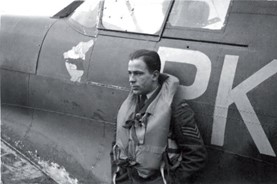
Flying Officer Stanislaw Blok DFC (Polish Ace)
Stanislaw Blok was born in 1916. His ancestors came to Gda?sk from Flanders. On 3 January 1939, he entered the Polish Air Force Academy in D?blin where he trained on PWS-10 and PZL P.7.
After the September Campaign, he was evacuated to the UK via Romania. After training he was assigned to the No. 315 Polish Fighter Squadron in 1941. On 19 August 1941, Blok scored his first victory on a Bf 109 near Dunkirk. On 21 September over Fruges, he shot down a Bf 109 and damaged another one. In the same year, he was promoted podporucznik (pilot officer). He served briefly with No. 603 Squadron RAF in early 1942, moving onto No. 54 Squadron RAF in April of that year. He returned to No. 315 in December 1942.
During World War II, Stanis?aw Blok downed five aircraft and one flying bomb V-1.
On the 10 March 1943, BS410 was detailed for Rodeo 180 to Trouville with the pilot being F\L S Lukaszewicz. The weather was not great with 10/10ths cloud cover, but the squadron headed for Shoreham and coasted out at sea level climbing up to 24,000 feet 10 miles Wes of the Target. Suddenly they received a warning of 40+ bandits approaching below at 15,000 feet but they passed under, and no engagement occurred, the squadron crossed back out at 27,000 feet and headed home. That afternoon the squadron again witnessed enemy aircraft at the same height as the formation but there was no engagement.
P0519 F/Lt Stanislaw LUKASZEWICZ Joined 315 in December of 1942 and was with then till April of 1943. He was later killed during operation over France, when his aircraft Spitfire IX, EN 124 was shot down by flak. He also flew on 317 Squadron. He was awarded numerous Polish decorations for bravery. He is buried at St. Sever Cemetery in Rouen, tomb 23, row 4, sector I.
She was airborne again on the 18 March 1943 this time for a Scramble with Pilot Officer Dubielecki but no enemy aircraft were seen landing back at 12:55 Hours.
BS410 was required for Rodeo 194 on the 25 March, this time around the St Omer area with Pilot Officer Blok again at the controls. There was again full cloud cover at 8000 feet and the Spitfires departed at 16:35 Hrs heading for Beachy Head and onwards to coast in at Le Touquet. The swept around Bolougne at 24,000 feet but ran into heavy cumulus cloud. They headed to St Omer, Dunkirk and along the coast to Cap Gris-New. Near Sangatte control warned them of enemy aircraft well below but nothing was seen. Halfway home they again received a warning of 20 + at 20,000 feet and they descended but nothing was observed and all landed safely at 18:30 Hours.
The 28 March 1943 saw her on the roster for Ramrod 48 with the target being Rouen, this time the pilot was Flight Sergeant S Grondowski. There was considerable cloud cover at 4,000 feet when BS410 got airborne and headed for Beachy Head, the regular rendezvous for the bombers and fighters. They received an order to land but whilst the orbited they saw the bombers heading for the French Coast and they joined them. As they approached France, the bombers turned for home due to the poor visibility and 315 did the same, landing back at 13:45 Hrs.
782063 W/O Stanislaw GRONDOWSKI served on 315 Squadron from February 1943 till September 1943.
On the 29 March 1943, BS410 was on the ops board for Circus 277 around St Omer with Grondowski again at the controls. It did not look promising first thing as the weather was cloud on the deck virtually but it soon lifted, allowing a window of opportunity. They took off at 12:55 Hours and crossed Dungeness at 1000 feet, climbing as they went, heading over Ambleteuse at 24,000 feet. They flew on towards St Omer and joined up with 316 Squadron near Mardyck. They turned towards Calais and on to Boulogne and back home via North Foreland with nothing to report.
Her next operational sortie was on the 14 April 1943. Airborne for Ramrod 55 to escort Bomphoons (bomb carrying Typhoons) however, on this sortie BS410 had engine trouble and returned to base with Pilot Officer Kuryllowicz at the controls.
P1952 F/Lt Piotr KURYLLOWICZ was later awarded the Cross of valour and a bar to the award. He joined 315 during July of 1942 and served until May 1943. He was later shot down in BS410 and was taken Prisoner of War, interned in Stalag Luft 3 where he was for the great escape although he was not one of the escapers. After the war became a dentist and settled in Ontario, Canada.
18 April 1943 Ramrod 64 to Courtrai Airfield with Pilot Officer K Wyrosemski at the controls, taking off at 17:45 Hours as a fighter escort to 8 Bomphoons again. This time the target was Courtrai airfield. The fighters flew at sea level and then climbed up to 21,000 feet over the French coast, sweeping round North of Bethune, over Hardelot and up to Cap Gris Nez. No trouble was reported, all landed back safely although one aircraft had returned early due to problems with a jettison tank.
P0779 F/L Ksawery WYROZEMSKI had joined 315 during April 1942 and was with them until the end of the war. He was awarded a Polish Cross of Valour and bar. He survived the war and went on to work for the CIA in the Congo in 1964. He was an airfield commander and was responsible for the retraining of the Cuban exile pilots hired by the CIA. Reportedly, he also collected some intelligence material on local tribes. He was killed in a car accident when the jeep driven by the local driver overturned.
19 April 1943, BS410 was taken on Ramrod 65 again with Wyrosemski and this time escorting Bomphoons to attack a power station. Nine Spitfires took off at 07.40 Hrs as a fighter escort to 4 Bombphoons to attack Yainville power station. They routed out at sea level from Shoreham and made landfall at Etretat at 21,000 feet. They received some flak around the Havre area which was at the correct height but was mainly behind them. They received a warning of enemy aircraft activity, and one aircraft was seen but not identified. They all landed safely at 09:20 Hours.
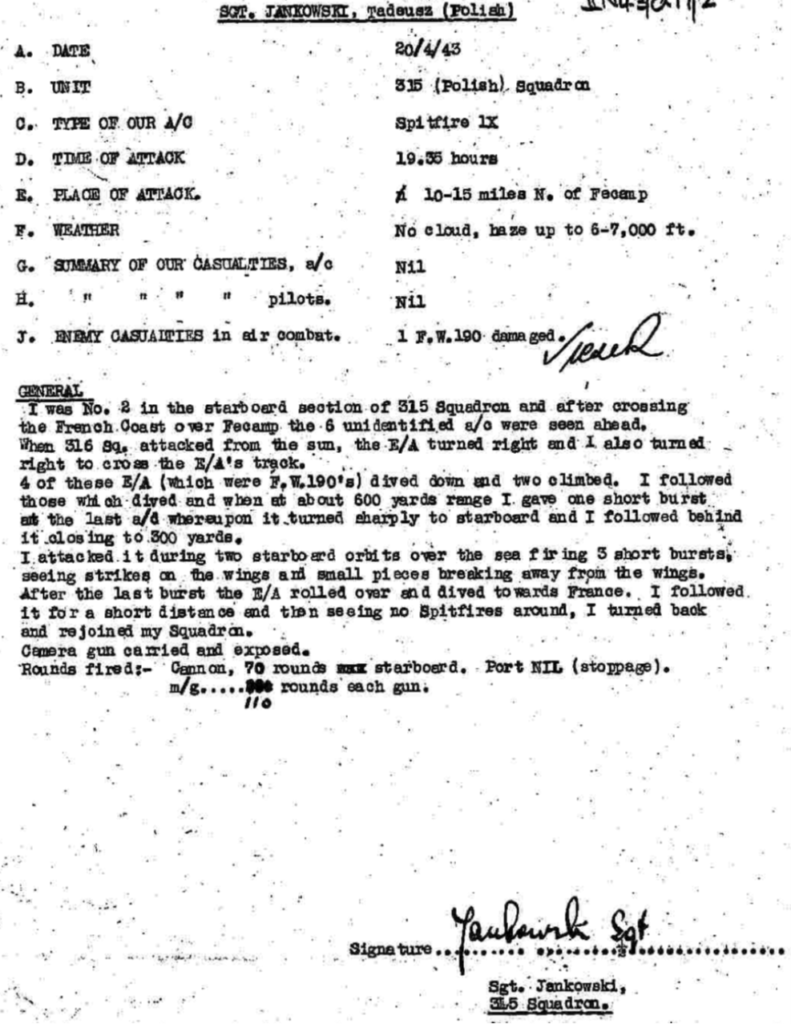
On the 20 April 1943, BS410 was again required, this time for Ramrod 67, and it was on this day the pilot, Jankowski, shared an Fw 190. The operational summary best sums up the day:-
A good day for the Squadron, for this evening operation gave us a bag of one enemy aircraft destroyed and two damaged. On this operation the new C/O Squadron Leader Poplawski, led the squadron for the first time. At 18.05, 9 aircraft took off as first fighter echelon to 8 Bomphoons having yet another go at Tricqueville airfield. Zero feet was maintained for 19 minutes from Selsey, and landfall was made 10 miles West of Bayeux at 19,000 feet. We swept 15 miles South of Bayeux and came out over Fecamp, being warned of 6 enemy aircraft Northeast of Caen. Over the coast at 27,000 feet 6 enemy aircraft were seen flying North, 5 miles ahead in line abreast. The Wing turned left to climb and attack from down sun. We dived to attack and one Fw was destroyed by F/O Dubielecki, while the Squadron Leader and Sergeant Jankowski (in BS410) damaged on each. We had no casualties and made landfall over Beachy Head at 15,000 feet. There was haze up to 7,000 feet but no cloud. The huns we bounced were under the impression that we were ahead of them and were hoping to bounce us. Which was just too bad for them.
Below is a copy of his combat report.
21 April 1943, BS410 is tasked for Rodeo 210 with Tarkowski back at the controls.
1 May 1943 Circus 293 Sgt K Lojeck on Circus 293 escorting Bostons to Caen.
4 May 1943 Ramrod 68 with 70 B17s to bomb Antwerp and on this sortie they ran into a mass of FW190s. Grondowski was the pilot for this trip the ORB reported, plenty of action and flak!
13 May 1943, Spitfire BS410 took off as part of Ramrod 71 to escort 88 USAAF B17s on a raid on the Potez factory at Meaulte as a daylight raid. They were attacked by a mixture of Bf 109s and Fw190s, heavy fighting occurred and Kuryllowicz reported cooling trouble, and he was seen going down. Of the formation of B-17‘s and their Spitfire escorts at least 3 of the B17s didn’t make it home and 5 Spitfires were lost. Piotr Kuryllowicz recalls his final moments as he tried to get out of his damaged aircraft.
BS410 Bailout, 13 May 1943,
I decided to abandon the aircraft. I didn’t climb the aircraft as I knew it would expose me to more fire from anti-aircraft fire or fighters, so I pushed the stick forward and put her into a dive, full throttle forward and open the canopy. To open the canopy there are two silver rubber balls, the size of golf balls in front of the rear-view mirror which we had in the Spitfire and Hurricane. If you pulled the balls, they pulled the wire that went either side of the canopy to a cone shaped lock and pin.
This should release the locks and the canopy should fly off, well it didn’t it got stuck, the lock didn’t work, I tried hard with, both hands pushing to move the canopy, I think I lost my watch trying to open the canopy, I was trying very hard to get rid of it and just could not. The lock was holding it and the air pressure over the canopy was holding it in place as the aircraft was in a dive. I couldn’t get rid of the canopy so I couldn’t get out of the bloody aircraft. After trying all the other methods, pulling, pushing, trying with my both hands I don’t remember how but I got hold of the crowbar, which was mounted just inside the door, mounted in u shaped clips of metal, I reached for the bar, held it in my hand and put it in between the lock and the canopy.
It was a miracle that I didn’t drop the bloody thing otherwise I wouldn’t still be here if I did. It acted as a first-class lever and the canopy just flew off which was wonderful. I knew I was free; the canopy was open, so they next story is that I pushed the stick hard forward to be thrown out, I found myself catapulted out of it.
I should have gone clean out, but I didn’t, and the wind blew me back and I caught my foot on the armour plating on the side of the canopy. My aeroplane ended up in an inverted spin. As I say my right foot got stuck and my body was glued to the aircraft. All I could do was push and rotate until I was facing the fuselage and I had my hands against the fuselage, I managed to push myself away, loose in the air and very happy that I was there. I was lucky that my harness did not get stuck in the radio mast. I still had plenty of altitude, but I could see I was losing it quickly. I was free as a bird, and it all looked wonderful. I almost forgot I was outside in space; my Spitfire was far away. I opened the parachute.
I deliberately went through quite several thousands of feet without opening the parachute as I was fully aware that there was anti-aircraft fire and other aircraft fire in the combat area, and that other fighters might just want to finish you off in your canopy.
We were briefed many, many times, don’t open you parachute too soon, wait until you get right out of the area and as far away from the battle that was going on to a lower altitude and then you are reducing the risk of being hit by artillery fire and other fighters and you are for a much shorter time visible to the people on the ground in your parachute. If you are open, you parachute at 20,000 feet you are there for a heck of a long time and they are watching you come down. If you open, you chute at 1,000 or 2,000 feet they had a much shorter time to see where you’re going to land, and you had a better chance to escape.
I landed close to bushes. We had a pack around our neck to help escape on the ground, we had different kinds of money, French, Belgian and Dollars. I took it off and threw into the bushes because I knew there were French teenagers who would have picked it up and given it to the French resistance.
I had a damaged leg, and I was supposed to hide my parachute, it was not easy, I couldn’t bury the parachute. I was found by the Germans who had an Alsatian dog. To start with we were lying on a farmer’s floor, not just me, others also who parachuted out, we were placed in a truck. They took me to a first aid post to start with and then I was taken to hospital at Amiens for treatment and we were in an old school on the first floor.
It was in the hospital that I looked at my face, I didn’t recognise it, it was my face but instead of two eyes I had two swollen tomatoes instead of eyes, red. They said that was because of the inverted spin. I thought I would lose my eyesight, I never wanted to lose my eyesight, in my prayers I was saying please don’t let me go blind before I die as I didn’t want to walk around blind. You couldn’t see my eyes at all. It lasted a few weeks.
Thank God for the crowbar.
Piotr Kuryllowicz (Canada aged 102)
BS410 crashed into marshy ground at Occoches, near Doullens, north ofAmiens. F/O Kuryllowicz landed by parachute near to his crashed Spitfire but was soon taken prisoner by German troops and spent the rest of the war in Stalag Luft III PoW camp at Sagan. The remains of the Spitfire remained buried in the marsh until 11 December 2005,

Piotr in his Polish uniform and wings attached by chain to his collar. (Kara)
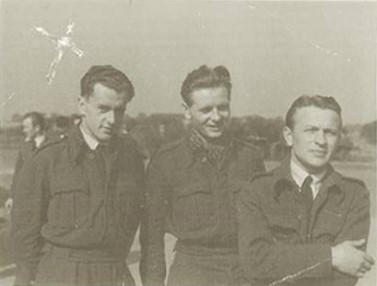
Piotr on the far left with some of his Squadron friends in 1943. (Kara)

Piotr in later life, living in Canada. (Kara)
The remains of the Spitfire remained buried in the marsh until 11 December 2005, when Pierre Ben and members of the The Association Somme Aviation 39-45 excavated the crash site, recovering parts of the cockpit, its Rolls Royce Merlin 61 engine, together with sections of the fuselage showing the serial number, BS410, along with No. 315 Squadron‘s crest.
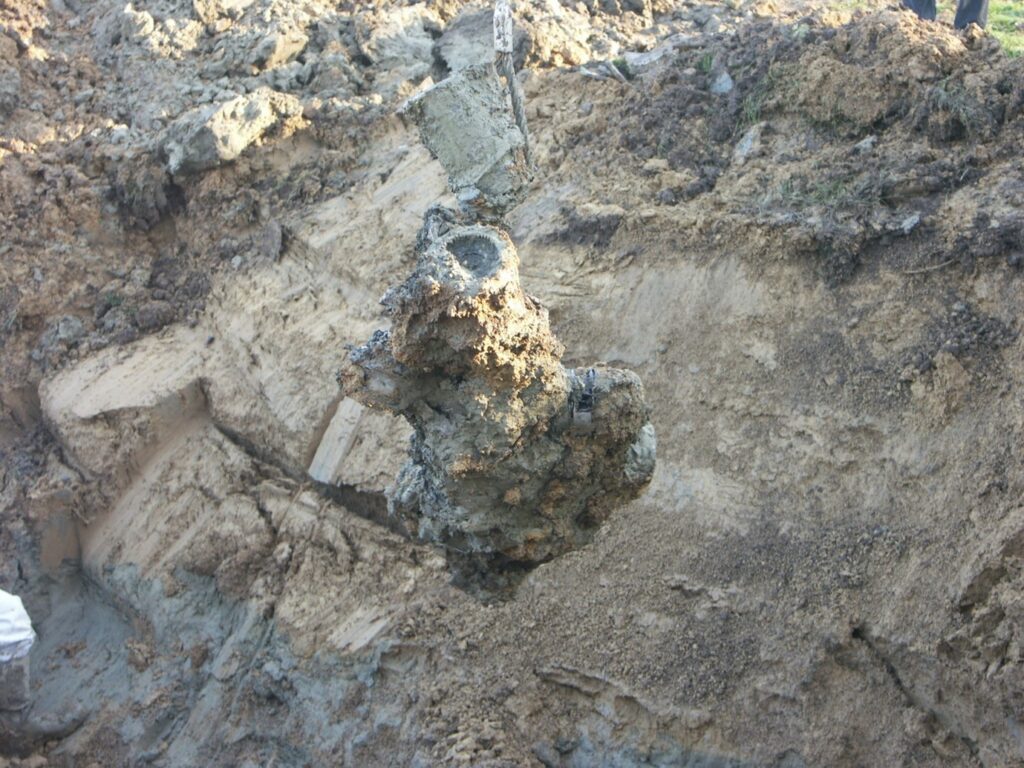
Parts of the Merlin 61 being lifted from the final resting place of BS410 in France. (MP)
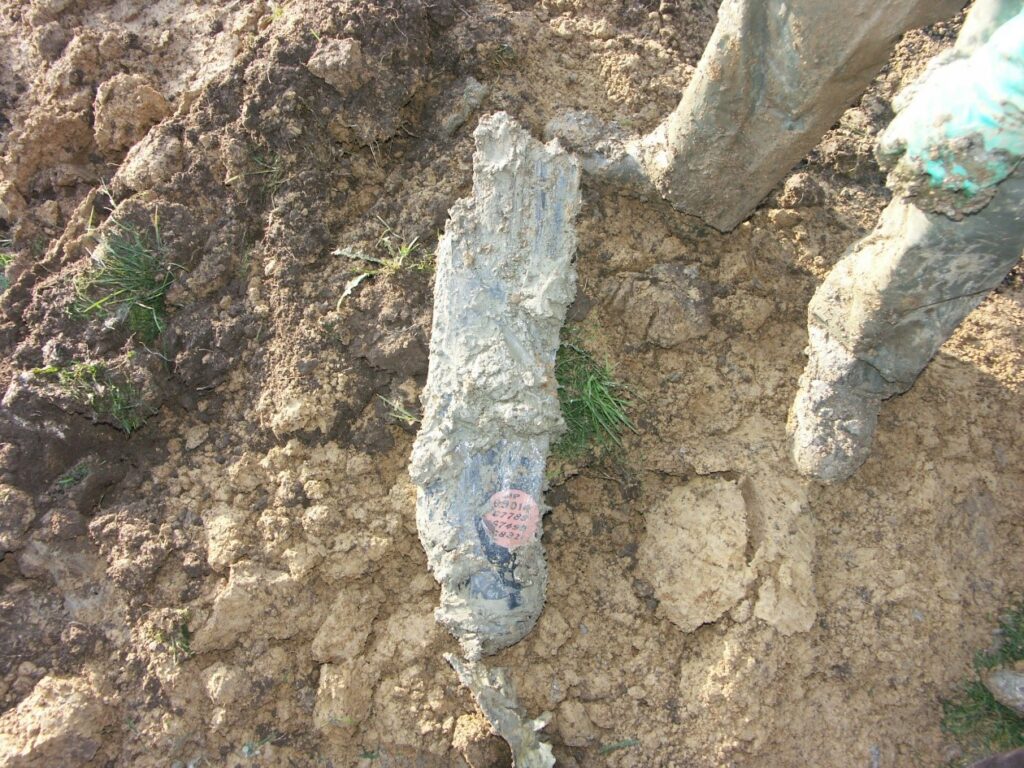
A piece of the propeller with its sequential prop numbers showing. (MP)

The large whole required to excavate the remains of BS410, she went in vertically to a considerable depth.(MP)
The aircraft was subsequently purchased by Martin Phillips of Exeter, who also owns Spitfire Mk HF IX RR 232, currently based at Goodwood in West Sussex. The airframe had much work conducted by Steve Vizzard’s Airframe Assemblies on the Isle of Wight, but its journey will now be completed at Biggin Hill Heritage Hangar.
During her re-build, in May of 2009, Martin Phillips was also able to re-unite Piotr Kuryollowicz with his mount of 1943. He has the opportunity to sit in the cockpit of his aircraft and Martin also presented him with a piece of the aircraft as a memento of his wartime service.
Its Merlin powerplant has been fully restored by Maurice Hammond’s Eye Tech Engineering and, has now been refitted. She is finished in 315 Squadron Colours, codded PK-A and should take to the sky again in March as a TR9.

Martin with the fuselage of BS 410 with the 315 Squadron Emblem and ‘PK’ Squadron codes. (Martin P)
Many thanks to Kara Kuryollowicz and her Family and especially to Piotr Kuryollowicz who kindly shared some of his memories. The aeroplane will fly again in 2020 and be a fitting tribute to his bravery and sacrifice as well as all the other Polish and commonwealth pilots who gave their lives for Freedom. Fighting in a foreign land for freedom.
Mark Hillier – Fontwell, England. 2022 – Spitfires.com